
The $10 Million Ceiling: 5 Counter-Intuitive Principles for Scaling the "Messy Middle"
By Steve Simonson
You have surpassed the scrappy phase. But somewhere between $1M and $10M, the rules of the game quietly changed. Here are five counter-intuitive principles to help you navigate the messy middle and break through to the next level.
You have surpassed the scrappy phase. You have a team, a product-market fit that resonates, and revenue crossing the critical $1M threshold. But suddenly, the "heroics" that catalyzed your initial success—the founder-led sales, the late-night manual workarounds, and the sheer force of hustle—have hit a wall. In fact, those very instincts have become the ceiling.
Somewhere between $1M and $10M, the rules of the game quietly changed. You are no longer just building a product; you are "flying an airplane while building it." The cockpit smells like burnt coffee, the wings are half-riveted, and your legacy systems are screaming under the pressure of altitude.
To break through to $10M and beyond, you must transition from a hustle-based startup to a professionalized operating system. This requires a shift from tactics to Axioms. Tactics expire; principles compound. Tactics are transient responses to market conditions; Axioms are structural foundations for growth.
Here are five counter-intuitive principles to help you navigate the messy middle.
1. The Paradox of Progress: Why Every Upgrade Is a Downgrade (At First)
In the pursuit of scale, you will eventually sign a contract for a new ERP, recruit a high-level VP, or overhaul your fulfillment architecture. You expect immediate relief. Instead, you encounter the Implementation Dip—a structural reality of growth also known as the Valley of Despair.
This is the period where new systems or senior hires actually make things slower, clumsier, and more frustrating. The phenomenon is not a technical bug; it is a human one. Your team, having built muscle memory around old "duct tape" systems, must now unlearn habits practiced thousands of times. For a period of months, performance will tank.
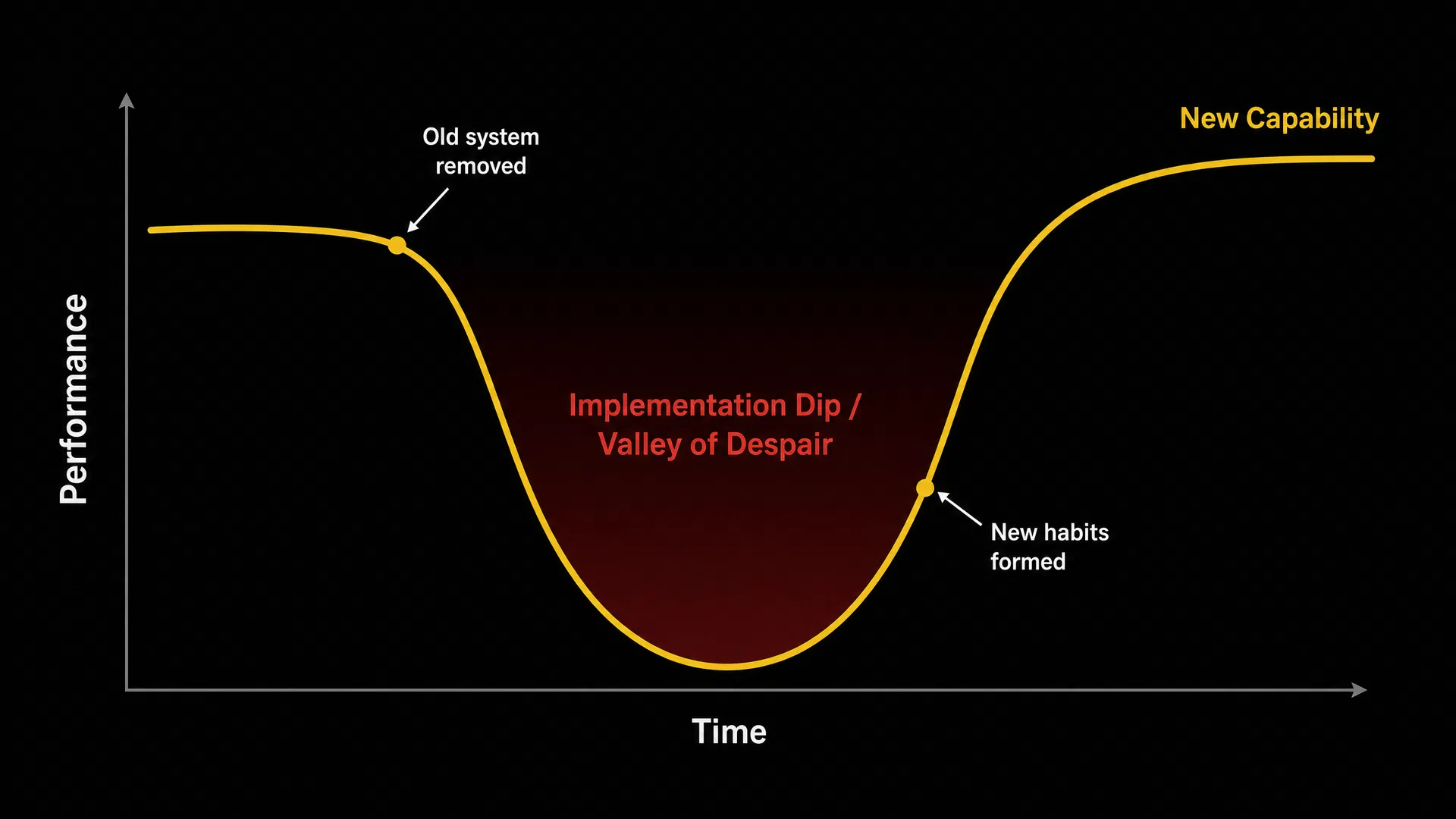
Consider Taiichi Ohno and the Toyota Production System. In the 1950s, Ohno introduced the andon cord—a literal pull-cord that allowed any junior worker to halt the entire assembly line the moment they spotted a defect. To plant managers accustomed to maximizing throughput at all costs, this looked like a catastrophic downgrade. The line stopped constantly. Throughput plummeted. Ohno was deeply unpopular for years.
However, because he "budgeted for the friction" and held the line through the trough, Toyota eventually emerged with a level of quality and efficiency that American manufacturers found impossible to replicate.
> "The actual problem is older and more durable than technical bugs. The axiom is about the humans... who are being asked to unlearn habits they have practiced thousands of times in order to learn new habits that, for the first three months, will be slower, clumsier, and more frustrating."
The Takeaway: Leaders often abandon the right initiatives at the wrong time because they misinterpret the "Implementation Dip" as a sign of failure. If you are not prepared to fund and defend the friction of unlearning, you will remain stuck with the duct tape that is currently capping your growth.
2. The "Stupidity" Advantage: Why You Should Avoid the "Opposite of Good"
In high-growth environments, there is a cult of "brilliance." But for the mid-stage founder, chasing genius is often an expensive liability. A more reliable edge comes from the philosophy of Via Negativa, or what investor Charlie Munger and mathematician Carl Jacobi called Inversion.
Instead of asking "How can I be a genius today?" the more rigorous question is: "What is the opposite of good here, and how do I prevent it?" Munger famously noted that long-term advantage comes not from being incredibly intelligent, but from being "consistently not stupid."
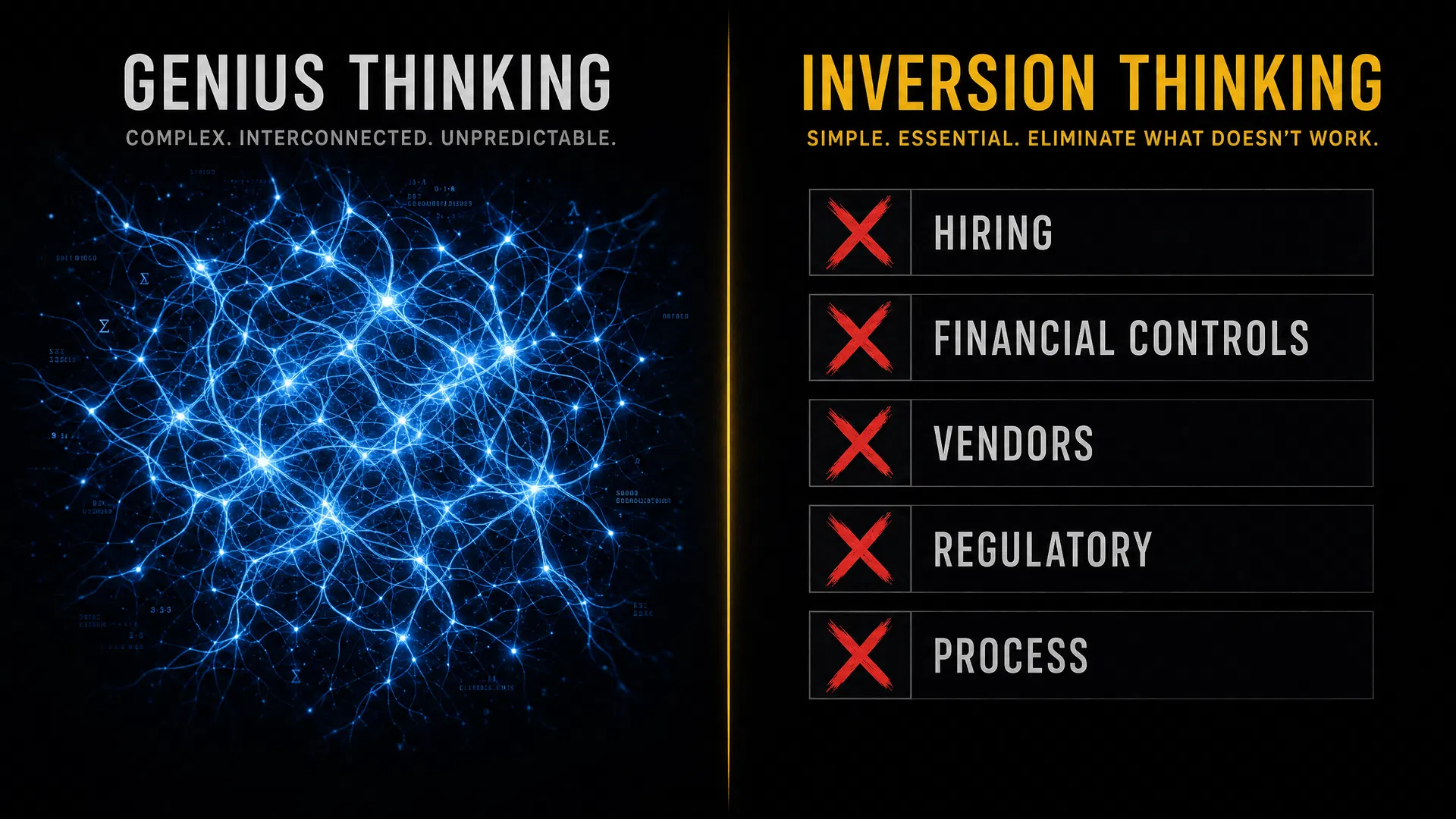
Founders habitually misclassify "preventable failures" as "bad luck." In reality, these are unforced errors hidden in five high-yield categories: Hiring (the interviewer who talks for forty minutes and listens for ten), Financial Controls (a lack of budget caps or approval thresholds), Vendors (no-shop deals with the first person who reaches out), Regulatory (skipping a five-minute search on HS codes or tax obligations), and Process (leaving a known broken handoff unfixed for six months).
> "It is remarkable how much long-term advantage people like us have gotten by trying to be consistently not stupid, instead of trying to be very intelligent." — Charlie Munger
The Takeaway: You don't need to find every winner; you just need to exclude the catastrophic, predictable losers. The wins take care of themselves once the "opposite of good" is systematically ruled out.
3. Innovation is a "No": The Discipline of the Four-Box Grid
Founders often die of a thousand "reasonable yeses." This produces a sprawling, incoherent business. When Steve Jobs returned to Apple in 1997, he found a company producing 350 different products. He famously drew a Four-Box Grid on a whiteboard: Consumer, Pro, Desktop, Portable.
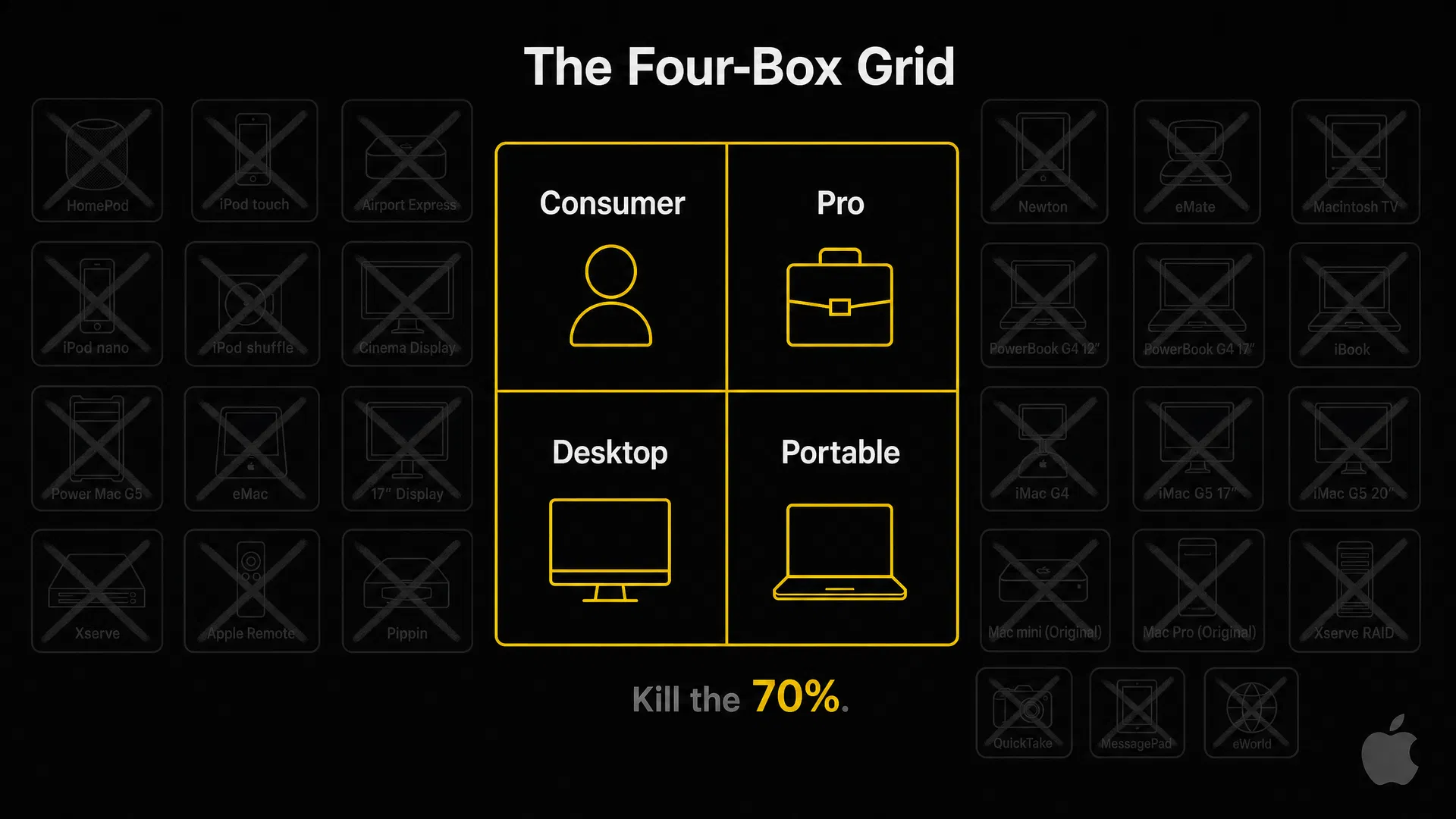
Jobs killed 70% of Apple's product line to focus on just four things. He understood a vital distinction: he wasn't "quitting" because the work was hard; he was "killing" based on the math of focus. In this framework, sunk costs are not regrets—they are tuition.
To implement this, your organization must adopt the "Juice Worth the Squeeze" framework. This is a democratic tool—anyone from an intern to the COO should have the standing to ask it about any project. The "Juice" is the realistic upside and value delivered. The "Squeeze" is the time, money, team energy, and opportunity cost required.
> "People think focus means saying yes to the thing you've got to focus on. But that's not what it means at all. It means saying no to the hundred other good ideas that there are... Innovation is saying no to a thousand things." — Steve Jobs
The Takeaway: Radical focus requires the maturity to "kill" initiatives that no longer justify the investment. True innovation is not the act of starting; it is the discipline of the "No."
4. The "Cobra Effect" and Axiom 9: The Countervailing Metric
"Running on vibes" is the most expensive leak in a $1M–$10M business. As the founder, you can no longer see every transaction; you need a scoreboard. However, a single metric is a trap that inevitably leads to gaming.
This is the Cobra Effect, named after the British colonial government in Delhi that offered a bounty for dead cobras. Enterprising citizens began breeding cobras to collect the bounty. When the program was canceled, the breeders released their worthless snakes, leaving the city with more cobras than when they started.
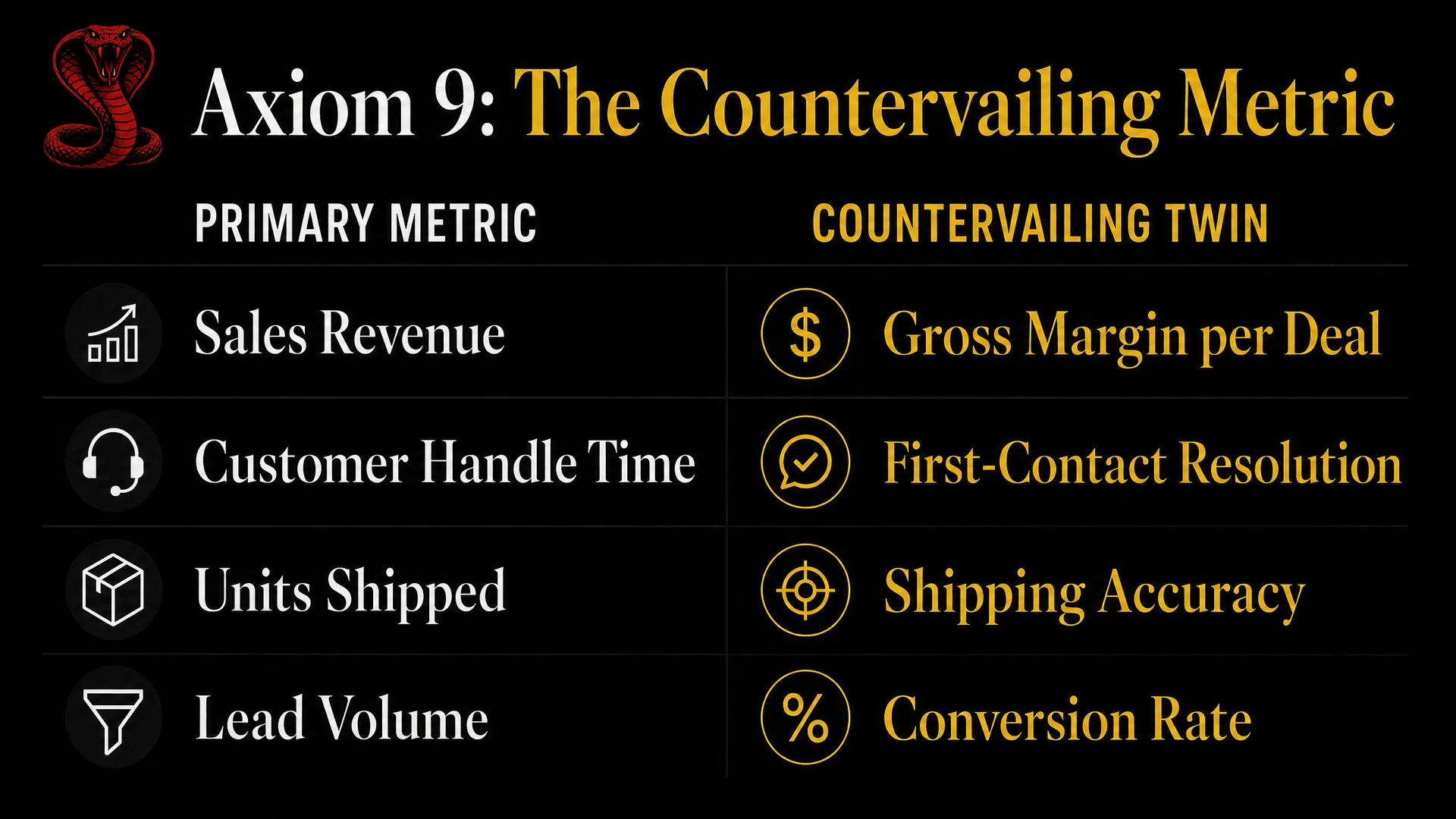
In your business, siloed optimization is organizational suicide. The solution is Axiom 9: The Countervailing Metric. Every metric that drives behavior needs a twin to maintain balance. Sales Revenue must be paired with Gross Margin per Deal. Customer Handle Time must be paired with First-Contact Resolution. Units Shipped must be paired with Shipping Accuracy. Lead Volume must be paired with Sales-Qualified Conversion Rate.
The Takeaway: Without a scoreboard, management is guesswork. But without a balanced scoreboard, your team will efficiently optimize you into a worse business. Every behavior-driving metric must have a twin.
5. The WD-40 Mindset: Bridging Humility and Iteration
To scale, a founder must confront the disease of intellectual arrogance. In Axiom 0, the principle is "I don't know nuthin' about nuthin'." This is foundational humility. Like Socrates, the wise founder recognizes the "edges" of their own competence and refuses to walk past them pretending otherwise.
You cannot iterate if you are too arrogant to admit your first version is flawed. This brings us to the WD-40 Mindset. The product on your shelf today is a permanent monument to thirty-nine failed formulas.
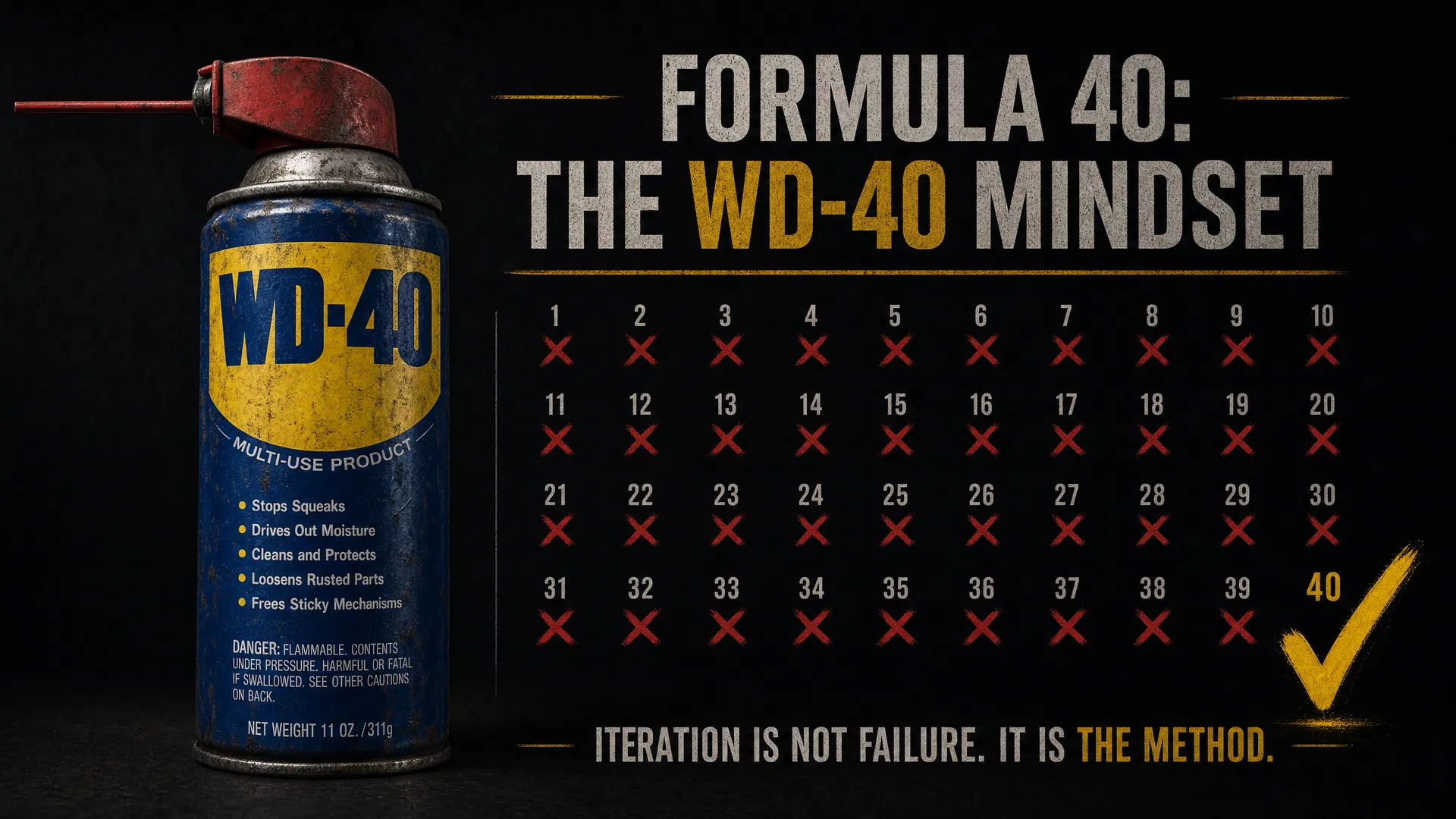
In a computer lab in 1982, a teacher named Mr. Taylor taught a vital lesson: "Your program will not work the first time you run it." This is an inoculation against panic. Many founders treat a disappointing first launch as a pathology. It isn't. The gap between your plan and your first result is simply the physics of operating in a complex environment.
> "The gap is not pathology—it's normal... the reminder, held in reserve for the moment that gap shows up, that the gap is not pathology—it's normal."
The Takeaway: Your role as a leader is to shift the team from alarm to structured curiosity. Admit you don't have the answer yet (Axiom 0), fix the code, and run it again (Axiom 20). The fortieth attempt is how you build a world-class operating system.
Conclusion: The Mirror and the Map
Operating a business in the "messy middle" is not a matter of following a checklist; it is a matter of adopting a diagnostic operating system. These Axioms are a mirror to help you identify which principle you have been ignoring in the heat of the hustle.
Scaling requires you to stop being the "smartest person in the room" and start being the engineer of an environment where data and systems do the heavy lifting. Profit, after all, is simply "the market's receipt for value delivered."
Which axiom are you currently ignoring that, if adopted, would break your current ceiling?