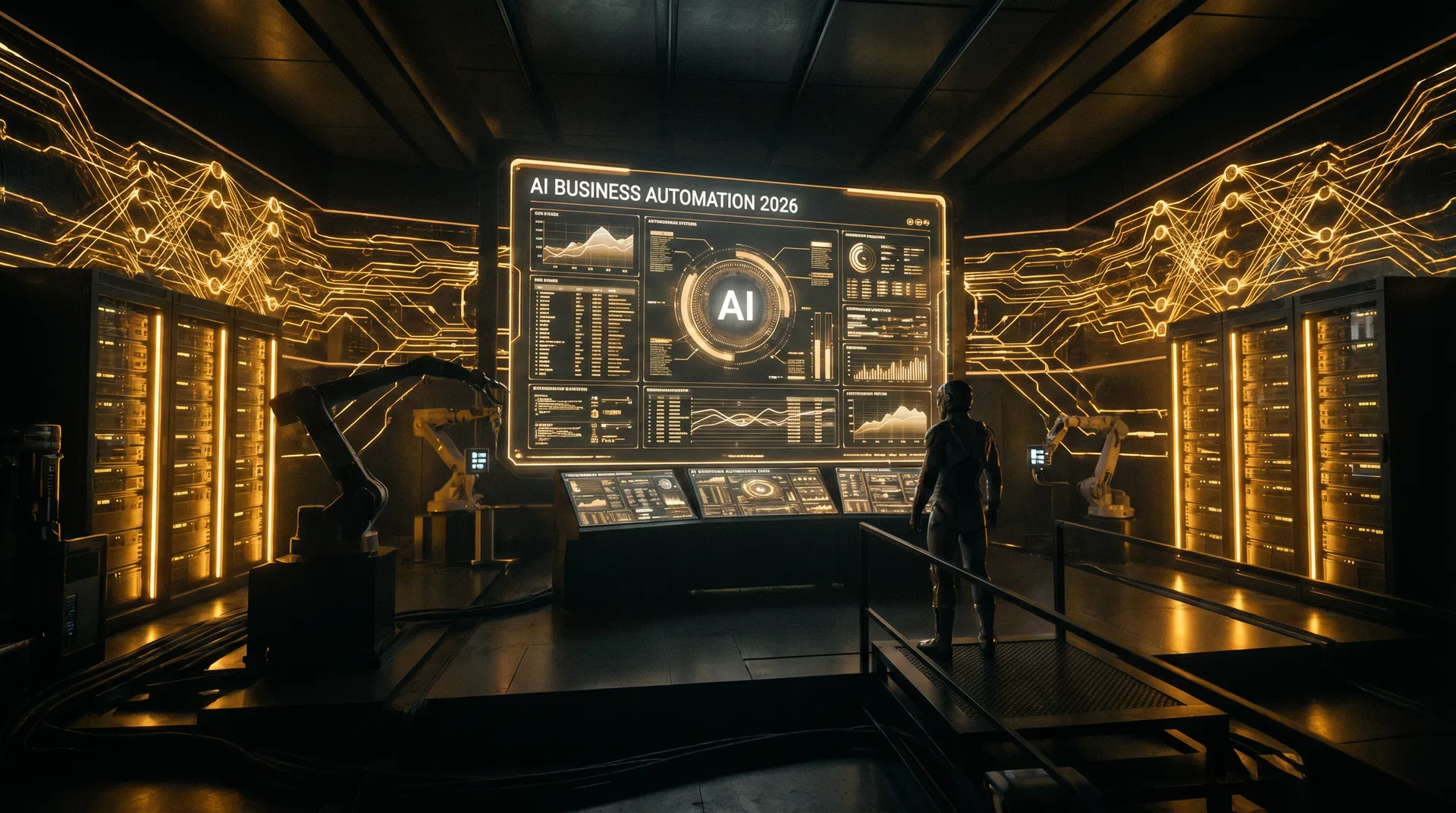
The AI Tech Stack of 2026 (or: “Wait… this thing runs my business now?”)
By Steve Simonson
A CEO's honest, unfiltered tour of the AI tech stack now quietly running his business in 2026, from agents to daily ops, and what to copy first.
What Is an AI Tech Stack?
- The Confession (aka why I ignored AI way too long)
- What Actually Changed in 2025–2026 (and why you can’t ignore it now)
- The AI Tech Stack of 2026 — A CEO’s View (not a developer’s)
- AI Agents: The Thing Everyone’s Talking About (and half understanding)
- The New Ecommerce Org Chart (hint: fewer humans doing weird repetitive stuff)
- Where CEOs Are Screwing This Up (gently… kind of)
- The Stack That Actually Works (practical breakdown)
- What This Means for Amazon FBA & Shopify Operators
- A Few Opinions You May Disagree With (but hear me out)
- Final Thoughts + One Slightly Self-Serving Ask
The AI Tech Stack for Business in 2026: Is AI Running Your Business Yet?
Alright, quick confession.
Last year—no, actually, early 2025—I tried to “delegate AI” to someone on my team. I literally said, _“Hey, can you go figure outChatGPT or whatever and let me know if it’s useful?”_
Yeah. That aged… poorly.
Fast forward to now, and I’ve got AI writing product descriptions, handling customer tickets at 2:13am (better than I ever did, frankly), and—this is the part that still freaks me out a bit— _making decisions I used to spend three espresso shots and a whiteboard session on._
Oh—and one time it rewrote an entire PDP while I was eating a slightly stale protein bar in my car outside a Costco in Tacoma. (Don’t ask. Long story. Something about bulk almonds.)
Anyway.
If you’re a CEO in ecommerce—Amazon FBA, Shopify, DTC, whatever—you’re probably in one of three camps right now:
- You’re all-in and slightly overwhelmed
- You’re experimenting but… it feels scattered
- You’re quietly hoping this whole “AI agents” thing is a phase
It’s not.
And honestly? That’s probably a good thing.
What Actually Changed in 2025–2026
Okay, so let’s clear something up.
AI didn’t just “get better.” It got operational.
That’s the shift.
We went from:
- “AI writes emails and blog posts”
To:
- “AI runs workflows, makes decisions, and coordinates systems”
And yeah, I know that sounds like hype. I thought the same thing. My friend Jake (not his real name… or maybe it is) literally said, _“This feels like NFTs with better branding.”_
He’s now using AI to manage inventory forecasting.
So.
Here’s what actually changed:
- Models got cheaper (like, dramatically cheaper)
- Context windows got huge (they remember _everything_)
- Tools became composable (APIs everywhere)
- And—this is the big one—AI agents emerged
Which brings us to…
The AI Tech Stack of 2026 (CEO Edition)
Look, I’m gonna simplify this. A lot.
Because if you’re running a brand doing $5M–$100M, you don’t need a PhD in machine learning. You need to know:
> “What pieces matter, and how do they fit together so my business actually runs better?”
So here’s the stack, stripped down to what actually matters:
1\. Foundation Models (The Brain)
These are your GPTs, Claudes, Groks, etc.
You don’t need to obsess over which one is “best.” That’s like arguing over which espresso bean changed your life.
They’re all… good enough.
What matters:
- Speed
- Cost
- Reliability
2\. AI Agents (The Operators)
This is the big one.
AI agents are basically:
> “AI that doesn’t just answer—it _does things_.”
They:
- Take inputs
- Make decisions
- Execute tasks
- Loop until the job is done
Think of them like junior operators… except they don’t sleep, complain, or accidentally delete your Shopify theme at 11:47pm.
(_That definitely didn’t happen to me in 2023._)
3\. Tool Layer (The Hands)
Agents need tools.
These are things like:
- Shopify API
- Amazon Seller Central integrations
- Klaviyo
- Google Sheets (yes, still… somehow)
- Your ERP
Without tools, AI is just… talking.
With tools? It’s running your business.
4\. Memory Layer (The “Oh right, that customer hates blue packaging” part)
This is where things get spooky.
AI now remembers:
- Customer preferences
- Past decisions
- Brand voice
- Operational patterns
So instead of starting from zero every time…
It builds context.
Which means better decisions. Faster.
5\. Orchestration Layer (The Conductor)
This is where agents coordinate:
- Marketing
- Ops
- Customer service
- Supply chain
And yeah, this is where things start to feel like… _wait, who’s actually in charge here?_
Spoiler: still you. But also… kind of not?
AI Agents: The Thing Everyone’s Talking About
Okay, real talk.
Half the people saying “AI agents” right now couldn’t explain what one actually does.
Including me. For a while.
So here’s the simplest explanation:
> An AI agent is a system that can take a goal and figure out how to achieve it using tools, reasoning, and iteration.
Example:
You say:
> “Improve conversion rate on our top 3 products.”
An agent might:
- Analyze product pages
- Compare competitors
- Rewrite copy
- Generate new images
- A/B test variations
- Report results
All without you micromanaging every step.
It’s like hiring someone who… just _figures it out_.
Which, if you’ve ever hired before, you know is… rare.
The New Ecommerce Org Chart
This part’s weird.
Because your org chart is changing whether you like it or not.
It’s starting to look like:
- CEO
- Head of Strategy
- A few high-leverage humans
- A bunch of AI agents doing:
- Customer support
- Content
- Data analysis
- Inventory planning
- Ad optimization
And no, this doesn’t mean “fire everyone.”
It means:
> Humans move up the value chain.
More thinking. Less clicking.
(My friend Sarah—runs a mid-8-figure Shopify brand—cut her support team workload by 70%. Not headcount. Workload. Important distinction.)
Where CEOs Are Screwing This Up
Okay, I’m gonna be slightly blunt here.
Because I’ve made all of these mistakes.
1\. Treating AI Like a Tool Instead of a System
You can’t just “add AI.”
You need to rethink workflows.
2\. Delegating It Too Low
This is a leadership-level shift.
If you’re not involved, you’re behind.
3\. Chasing Shiny Objects
New tools every week.
Stop it.
Pick a stack. Build depth.
4\. Ignoring Data Quality
Garbage in, garbage out.
Still true. Annoyingly.
The Stack That Actually Works (Right Now)
Alright, if I had to sketch a practical setup for an ecommerce CEO in 2026:
Core Stack:
- Foundation model (OpenAI, Anthropic, etc.)
- Agent framework (this is evolving fast)
- Integration layer (APIs + no-code tools)
- Data layer (clean, centralized)
Supporting Pieces:
- Knowledge base (your SOPs, brand voice, etc.)
- Monitoring (so your AI doesn’t go rogue and offer 90% discounts…)
Example Use Cases (real ones, not hype):
- AI rewriting Amazon listings based on performance data
- Agents handling 80% of customer tickets
- Dynamic pricing adjustments
- Automated email flows that actually feel… human
- Inventory forecasting that doesn’t rely on “gut feeling + vibes”
What This Means for Amazon FBA & Shopify Operators
Let’s get specific.
If you’re running:
Amazon FBA:
- Listing optimization is now continuous , not one-time
- Review analysis becomes automated
- PPC can be partially agent-driven
Shopify / DTC:
- Your storefront becomes dynamic
- Personalization gets real (finally)
- Email/SMS flows evolve constantly
And here’s the kicker:
> The brands that adopt this early aren’t just more efficient—they become _harder to compete with._
Like… structurally harder.
A Few Opinions You May Disagree With
- Most agencies will struggle unless they adapt
- Hiring “AI people” is less important than training your existing team
- The best CEOs will spend _more_ time in operations, not less (but at a higher level)
Also—and I will die on this hill— Bad copy is still bad copy, even if AI wrote it.
Don’t get me started on those painfully generic product descriptions. You’ve seen them. We all have.
Final Thoughts (and a question for you)
So here we are.
AI isn’t coming.
It’s… already kind of running parts of your business.
Which is both exciting and slightly terrifying.
And I’ll be honest—I still have moments where I think:
_“Am I actually in control of this thing, or just supervising it?”_
Then I remember—this is just another tool evolution.
Like Shopify was. Like Amazon was.
Just… faster. And weirder.
So let me ask you:
Are you building a business that uses AI… or one that’s built around it?
Big difference.
And hey—if you made it through this slightly chaotic brain dump and didn’t hate it…
Maybe check out some of the other stuff I write about ecommerce, AI, and trying to not fall behind in real time.
No pressure though. Seriously. I’ll just be over here… arguing with an AI agent about email subject lines.
Don’t forget to check out the Catalyst88 Community.